

Your Safety System Isn't Broken. The Flow of Information Probably Is.
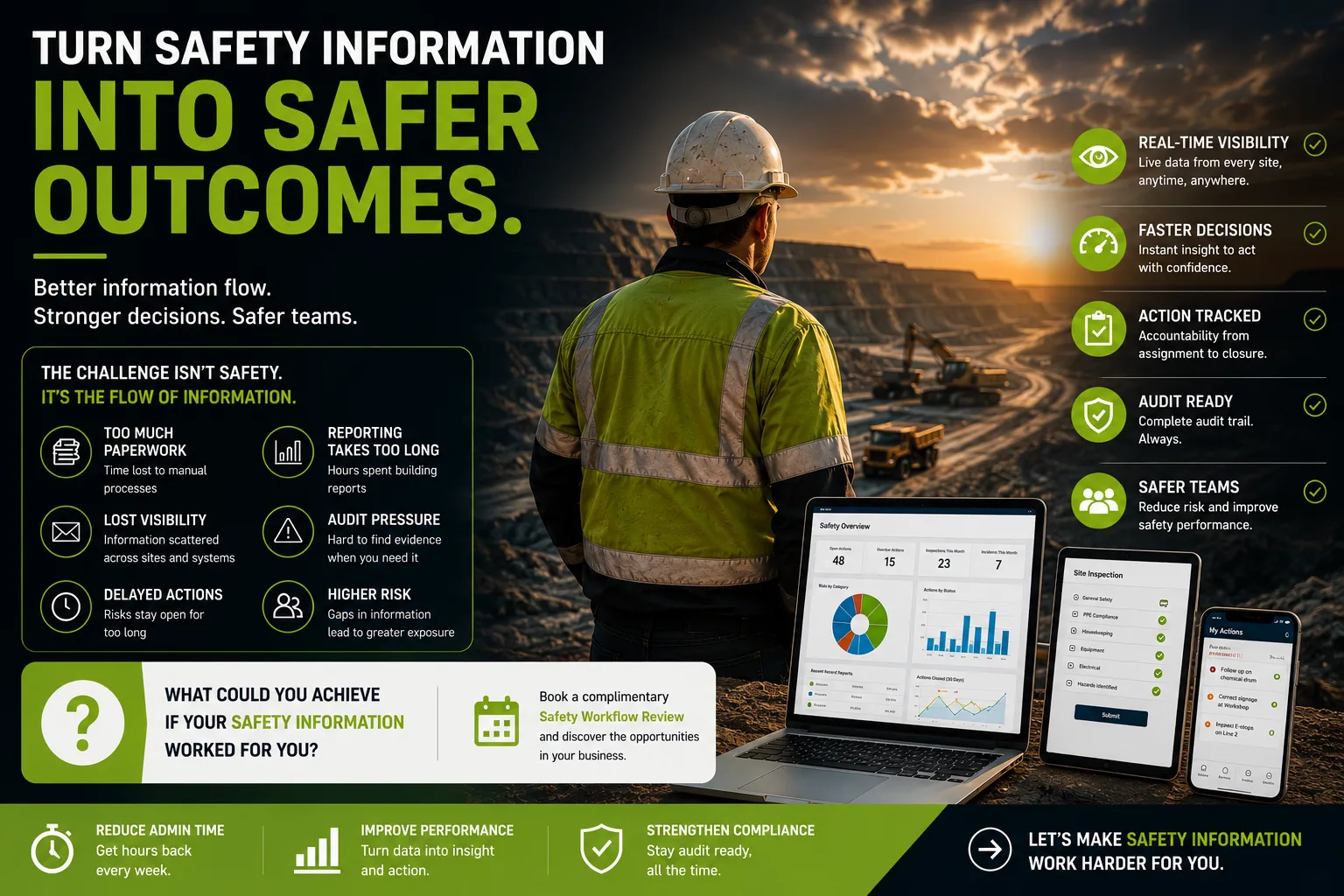
The Hidden Cost of Safety Administration
Imagine this.
It's Friday afternoon ...
A site manager has asked for a report on hazards raised this month, outstanding corrective actions, contractor compliance status, and recent inspections.
The information exists.
- Some of it is on paper forms sitting in vehicles.
- Some is buried in spreadsheets.
- Some is trapped in emails.
- Some lives in a safety system nobody fully trusts.
By the time the report is assembled, hours have been lost, information is already out of date, and the people responsible for improving safety have spent most of their time chasing paperwork instead of managing risk.
Sound familiar?
For many contractors, industrial businesses and mine sites, this isn't an occasional frustration. It's become normal.
And that's where the real problem begins.
The Safety Problem That Isn't Actually a Safety Problem
When most organisations look at improving safety performance, they focus on policies, procedures, training, audits and compliance.
These are all important.
But after working with many organisations, I have noticed something interesting.
The biggest barrier to effective safety management is often not the safety system itself. It's the flow of information.
Think about the typical journey of a safety observation, Take 5, hazard report, inspection or incident report.
An employee identifies a hazard.
- A form is completed.
- Someone reviews it.
- An action is assigned.
- The action is followed up.
- Management wants visibility.
- A report is generated.
At every step, there is an opportunity for delays, duplication, manual handling and lost visibility.
The result?
The organisation ends up spending enormous effort managing information instead of actually managing their risk.
When Good People Are Forced Into Bad Systems
Most supervisors don't come to work excited about completing paperwork.
I have never met a HSEQ manager who enjoy spending days compiling reports.
Operations managers don't want their frontline leaders trapped behind desks.
Yet this is exactly what happens when information is fragmented.
The irony is that organisations often have plenty of safety data. What they lack is visibility.
They know hazards are being reported.
They know inspections are happening.
They know corrective actions exist.
But they struggle to answer simple questions:
- What are our biggest risks right now?
- Which actions are overdue?
- Which sites are performing well?
- Where are recurring issues emerging?
- What trends should we be acting on?
Without visibility, leaders are forced to make decisions using incomplete information.
The Cost Nobody Measures
When organisations think about safety administration, they often focus on labour costs.
But the true cost is much larger. Consider the hidden impacts:
Delayed Corrective Actions
- When actions sit unnoticed, risks remain uncontrolled longer than necessary.
Reduced Supervisor Effectiveness
- Supervisors spend less time in the field and more time managing paperwork (Nobody wins)
Reporting Bottlenecks
- Management waits days or weeks for information that should be available immediately.
Audit Stress
- Teams scramble to find documents and evidence whenever audits occur.
Lost Opportunities for Improvement
- Valuable trends remain hidden because nobody has the time to analyse the data.
These costs accumulate quietly, month after month, year after year.
What High-Performing Organisations Do Differently
The best-performing organisations we've encountered share a common characteristic. They make safety information easy to capture, easy to access and easy to act upon. Information flows naturally from the frontline to management.
- Hazards become actions.
- Actions become accountability.
- Accountability becomes improvement.
- Leaders gain visibility without creating additional administration.
- Instead of spending time compiling reports, they spend time improving outcomes.
- Instead of asking, "Where is the information?" they ask, "What is the information telling us?"
That shift changes everything.
Safety Intelligence Beats Safety Administration
The future of safety management isn't about collecting more forms. It's about transforming information into insight.
Imagine being able to:
- Instantly see outstanding corrective actions.
- Identify recurring hazards across multiple sites.
- Access safety information from any location.
- Maintain a complete audit trail automatically.
- Eliminate duplicate data entry.
- Reduce time spent producing reports.
- Give supervisors more time in the field.
When information flows efficiently, safety becomes proactive rather than reactive. The focus shifts from administration to improvement. And that's where the greatest value is created.
One Question Worth Asking
If you could instantly fix one thing about the way safety information flows through your organisation today, what would it be?
The answer to that question often reveals the greatest opportunity for improvement. Not a new policy. Not another procedure. Not more paperwork.
Simply a better way for information to move through the organisation.
Ready to Explore the Possibilities?
At InnovateRx, we help industrial businesses, contractors and mine sites identify the bottlenecks, inefficiencies and hidden costs within their safety and compliance processes.
Sometimes the solution is surprisingly simple.
Sometimes it involves digitisation, automation or improved reporting.
But it always starts with understanding how information currently flows through your business.
If you're curious about where time is being lost, where visibility is limited, or how your safety processes could be working harder for your organisation, let's have a conversation.
Book a complimentary Safety Workflow Review
We'll help you identify:
- Administrative bottlenecks
- Reporting challenges
- Visibility gaps
- Opportunities for automation
- Practical improvements with measurable impact
Because the goal isn't more software.
The goal is safer, smarter and more efficient operations.