

Consistency always wins ... Always !

Walk any shop floor, quarry, or back office long enough and you'll spot it: the cable everyone steps over, the form that gets photocopied because the template's broken, the ute that always needs someone to walk to the shed for the right key. Nobody planned it. Everybody's just learned to work around it.
Paul Akers, who's spent two decades studying lean manufacturing up close, has a name for the fix: the two-second improvement. Not a project. Not a business case. Just that you see it, you fix it, right now, today. His argument is a simple one: a business that racks up hundreds of two-second fixes a year will out-improve a business that runs one twelve-month transformation program, almost every time.
That sounds almost too small to matter. It isn't, and the reason is compounding, not size.
Why the big launch plateaus and the small fix doesn't
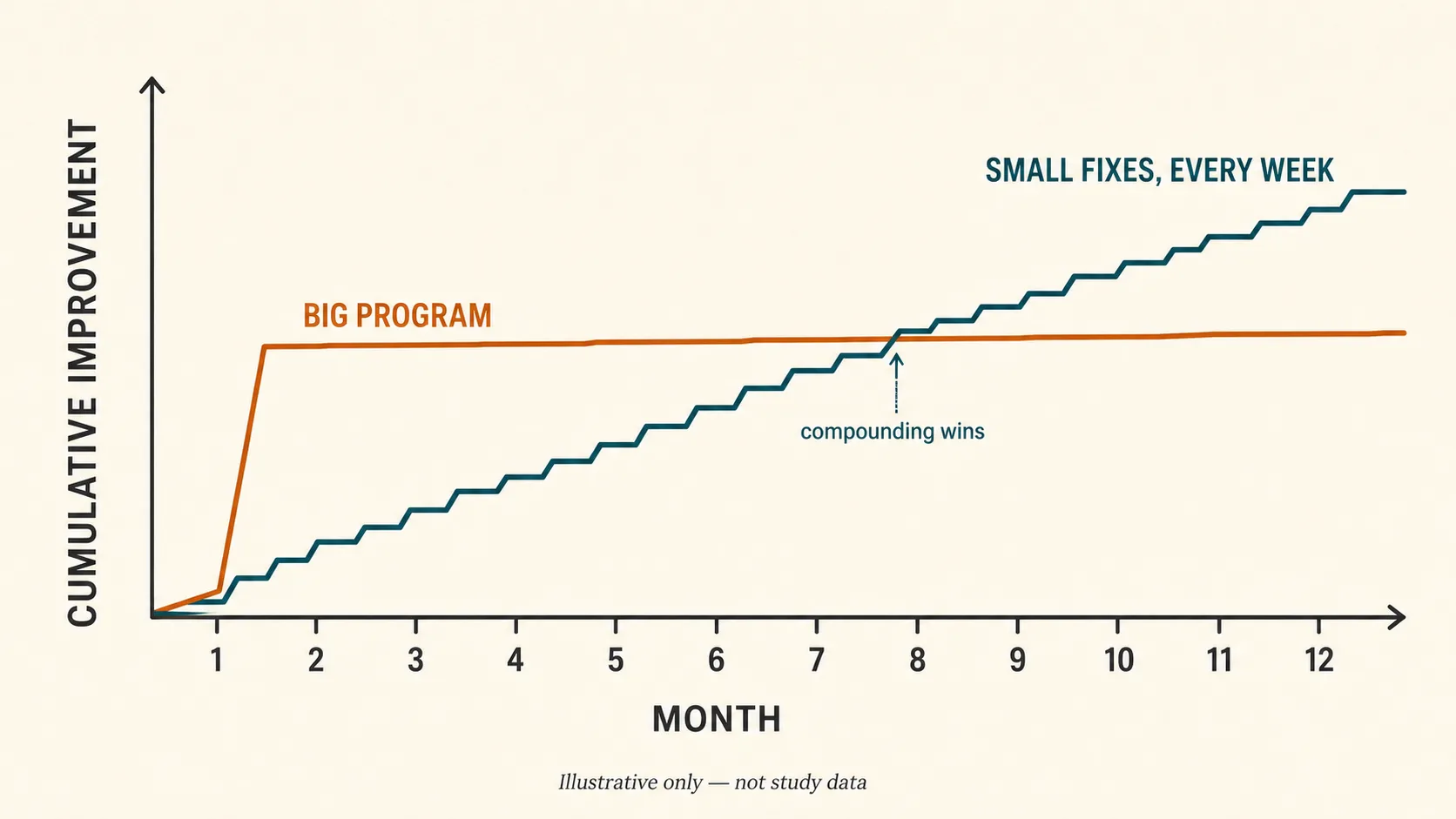
A major improvement program a new system, a restructured process, a consultant-led overhaul usually delivers its gain in one jump, at go-live. After that, most of the energy behind it goes elsewhere: the project team disbands, the champion moves on, and the gains it produced quietly become "just how things are" until the next big program is commissioned to fix what the last one missed (aka the ABC mockumentary "Utopia").
A culture of small, immediate fixes behaves differently. Nothing about it is dramatic in any given week. But it never stops, because fixing what's in front of you doesn't require a business case, a budget line, or a steering committee it just requires permission.
That's the part worth pausing and sitting with.
It isn't a habit it's a leadership decision
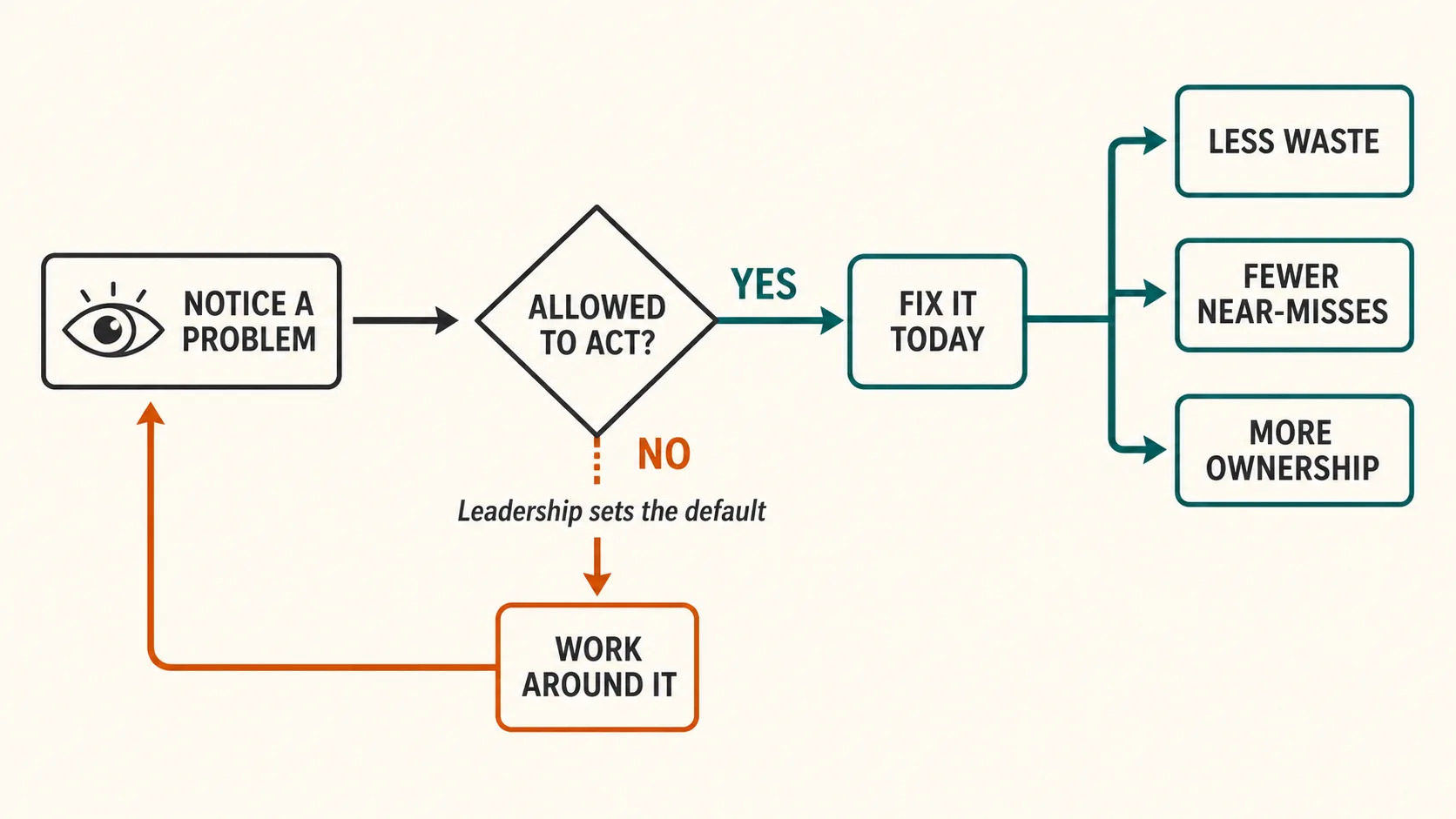
Katie Anderson, who's studied lean leadership through years of work with senior operations leaders, makes a point that cuts against how most businesses are run: the frontline usually already knows what's wrong. What determines whether it gets fixed today or ignored for another year isn't skill. It's whether the person who noticed it believes they're allowed to act on it and whether their manager will back them up or ask why they didn't fill in a form first.
That's a leadership habit, not a training program. It shows up in small moments: whether a supervisor stops to ask, "what have you noticed?" on a walk-through or walks straight past. Whether someone who fixes something without asking gets thanked or gently told to raise a ticket next time.
What it looks like in a real operation
A quarry that adopts this doesn't announce it. It shows up as a maintenance crew re-routing a hose so nobody trips on the same corner twice, an operator relabeling a valve after the third time someone opened the wrong one, an office manager fixing a broken spreadsheet formula the day it's found rather than working around it for a year. None of it is remarkable on its own. All of it adds up in fewer near-misses, less quiet frustration, and staff who feel like the place listens to them.
The chart below isn't a study result it's a rough sketch of the shape of the idea: one line is a major program that delivers its gain at launch and flattens out; the other is the same organisation making small fixes every week, all year. By month twelve, the small-fix line has quietly overtaken the big one not because any single fix mattered much, but because none of them stopped.
A question worth asking this week
You don't need a program to start this. You need one question, asked out loud, on your next walk-through:
What have you walked past twice this month ... and what's stopping you from fixing it today?