

The Skills Gap You've Been Managing Around Might Already Be Closing
Every operation has someone like this.
The senior estimator who prices a job in ten minutes when it takes anyone else half a day. The geologist who can read a core sample nobody else on site is confident interpreting. The accountant who spots the reconciliation error before the junior has finished running it.
Businesses build teams around these people. They also tend to accept that everyone else will take years to catch up, if they ever do.
For decades, that gap seemed fixed. Training and mentoring could narrow it, but only at roughly the pace that experience allowed.
Thomas Davenport has spent more than twenty years studying how businesses use information to make decisions. His argument challenges a common assumption: the biggest gains do not come from automating people out of the process. They come from giving people better support at the exact moment they need to make a call.
The aim is not to replace judgement. It is to improve it.
What the research found
A large study of professional staff at a global consulting firm tested this idea. The findings were later widely reported by Wharton professor Ethan Mollick.
Experienced and less experienced staff were given the same structured support while completing their work. Researchers then measured what happened to the quality of their output.
You might expect the strongest performers to pull further ahead. They already know how to use good information, so giving them better tools should increase their advantage.
That is not what happened.
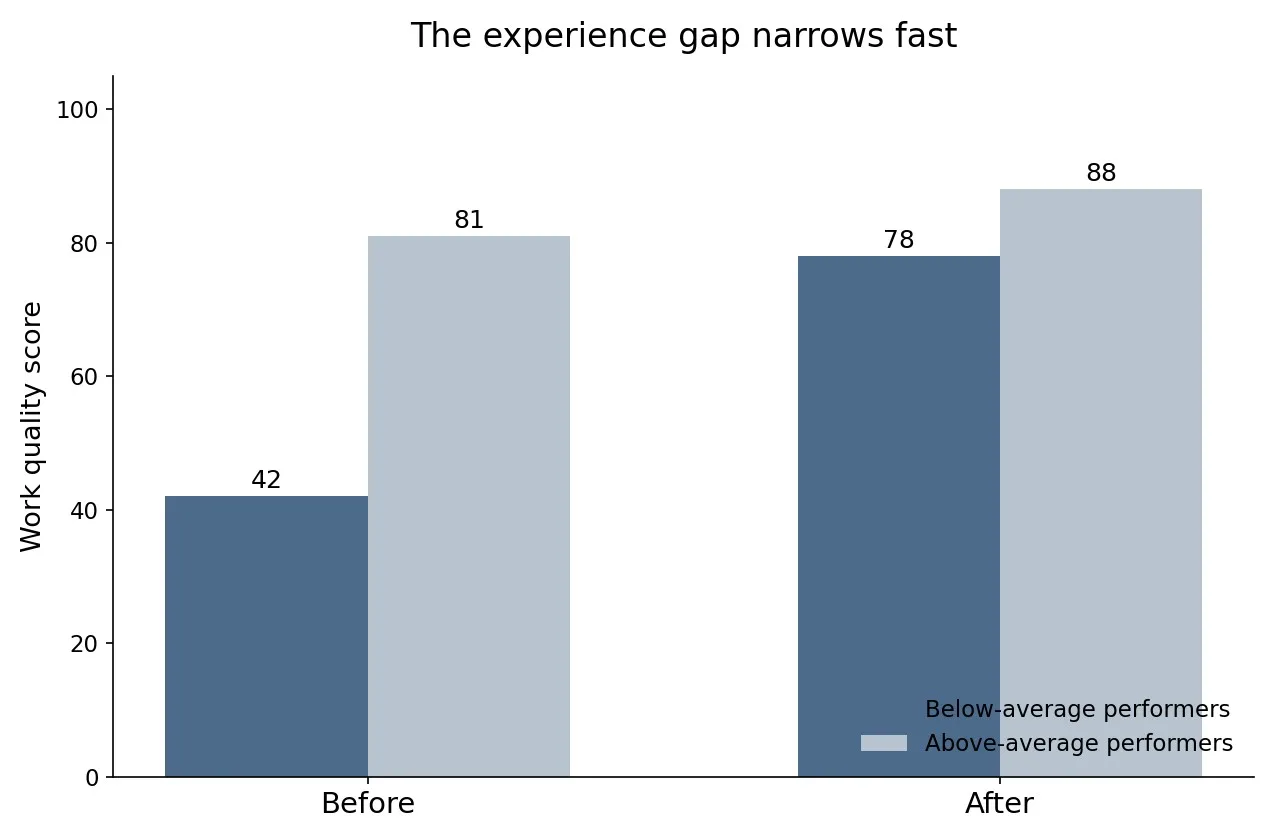
The largest improvement came from people who had previously been performing below average. The gap between the firm’s strongest and average performers narrowed sharply, and it happened almost overnight.
This is not simply a story about technology. It is a story about where the value of experience sits.
A meaningful part of that value can be captured, structured and handed to someone else much faster than most leaders assume.
What this looks like on site, in a plant or within the ledger
When a quarry loses its most experienced blast supervisor to leave or retirement, it has traditionally accepted months of reduced confidence while someone else grows into the role.
A manufacturer running a second shift with a less experienced supervisor often treats the resulting quality gap as the unavoidable cost of operating two shifts.
An accounting firm expects a graduate’s reconciliations to need a senior’s eyes on every line for at least the first year.
Those gaps do not have to be treated as fixed.
The answer is not always to find rarer people or wait longer. Often, it is to give the less experienced person the same structured reference points that your best person already carries in their head, right when a judgement call needs to be made.
The chart below shows the basic shape of it.
Two groups begin a long way apart. Both receive the same support, but the lower-performing group improves faster. A gap that once took years to close can shrink in weeks.
The stronger group has not gone backwards. The other group has simply caught up faster.
A question worth asking this week
If your best estimator, most experienced operator or most trusted senior took three months of leave tomorrow, how much of what makes them your best would disappear with them?
And how much of it could you have already handed to someone else?
The skills gap is a very real risk to business continuity - Technology can help with the knowledge transfer from your most talented & valued team members to the next generation. Contact InnovateRx to discuss how to surface, record and make your know how highly available in a safe & secure way.
Book a discovery call to explore how we might help reduce key person risk and equip the next generation.