

Automation Does NOT Replace Your Best People .... It REVEALS Them
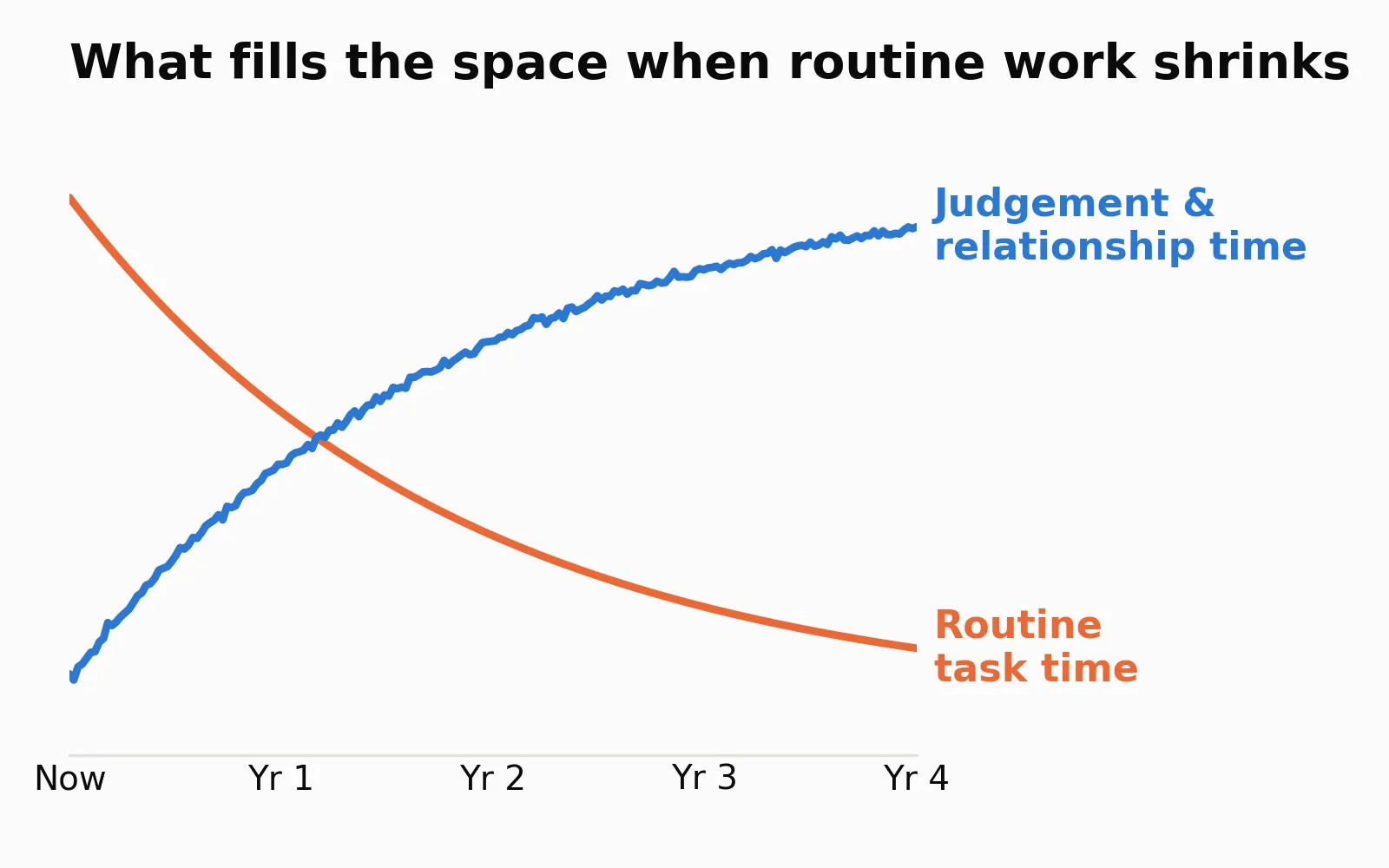
Consider this scenario - A tender goes out for review. Ten years ago, someone spent a full day checking every line by hand, catching the odd pricing error and the occasional missed clause. This year the same first pass takes twenty minutes, handled automatically. Nobody misses the twenty minutes. What nobody has decided yet is what happens to the rest of that person's day.
Where might your teams newly created time resource be directed?
That gap, the one that opens up after the routine part of a job shrinks, is where most businesses quietly get automation wrong. They measure how much time or headcount they have saved and stop there, as if the story ends when the repetitive work disappears. It really does not. It just moves the question to somewhere harder to answer: what should this person be doing now that actually needs them?
- It's an important question ... Perhaps it feels daunting to answer - The good news is that there are methods to identify where and how to deploy resources for greatest positive impact ... more on that later.
WHAT THE RESEARCH IS ACTUALLY WARNING ABOUT
Pascal Bornet, who has spent his career studying how organisations adopt new technology and, more importantly, which ones survive it, makes a case that should worry any leader who thinks the job is finished once a new system goes live. His research points to roughly half of today's S&P 500 companies being replaced within a decade, not because their technology falls behind, but because they never work out what to do with the people whose routine work technology took over. Perhaps that's an overly dire prediction, but it does make you pause and think ... what about my organisation?
The businesses that come through this well, in Bornet's framing, are not the ones with the newest tools. They are the ones that deliberately grow what he calls "Humics", the genuinely human qualities of judgement, creative problem solving and trustworthy relationships that no system replicates. Automation frees up the hours. Whether that time turns into something valuable is a decision a business has to make on purpose. It does not happen by itself.
A CASE WORTH KNOWING ABOUT
John Deere is a useful example precisely because it is not a technology company. As its equipment got smarter, capable of guiding itself and flagging problems on its own, the business had an obvious choice to make about the farmer behind the wheel. It chose to put the farmer more firmly in charge of the decisions that matter, what to plant, where, and when to act on what the equipment reports, rather than easing them out of the loop. The company's share price has climbed roughly 400 percent since 2016, a period that lines up closely with that shift. It is not that this happened despite the technology. It happened because of a specific decision about where to keep the human.
- "It happened because of a specific decision about where to keep the human."
Think about what this reveals ... teams of people remain an organisations greatest asset - Rightly designed and fitted technologies multiply what us wonderful humans can accomplish. Automation is multiplication rather than replication.
- "Automation is multiplication rather than replication."
WHAT IT LOOKS LIKE IN A REAL OPERATION
A quarry that automates its haul truck scheduling does not get its best value from the software alone. It gets that value when the dispatcher whose day used to be swallowed by manual scheduling is freed to spot the pattern the software cannot, like which driver is quietly struggling or which pit face is about to become a bottleneck. An accounting firm that automates data entry into reconciliations gets little from that on its own. It gets real value when the graduate whose day used to be entering numbers spends that time instead learning to read what the numbers mean for the client sitting across the desk. A manufacturer that automates quality checks on a line still needs someone deciding what to do when the same defect keeps recurring for a reason the sensors cannot diagnose.
- The legal practice which trims 1 minute off a multiple times per day repetitive task for both admin and fee earners only has to redirect some of those saved minutes into billable work to realise substantial (HUGE) revenue gains across a team. The numbers for professional services like legal, accounting, consultants ... any organisation billing hourly rates are WOW !
In every case, the technology did the same thing: it moved the routine work out of a person's day. What separated the businesses that gained from it, from the ones that just cut a role, was a deliberate decision about what to put in that space instead.
The chart at the top of this article sketches the idea. As routine task time in a role shrinks, there are two paths. One is a role that simply gets smaller. The other is a role where judgement, relationships and problem solving expand to fill the space, and become worth more than the routine work ever was.
A QUESTION WORTH ASKING THIS WEEK
Think of the last task your business automated or simplified. Ask what happened to the hours it freed up?
Were they filled with something that genuinely needed a person, or did they just quietly disappear into busier calendars and a smaller team?
How do I identify where best to redirect CAPACITY gained within my team?
ROOT CAUSE ANALYSIS
InnovateRx will help you map route causes and identify the most interconnected challenges creating the most impact. Our experience and method help our clients create positive feedback loops that fuel ongoing business improvement. Click the contact form to explore whether InnovateRx might be able to help you.